
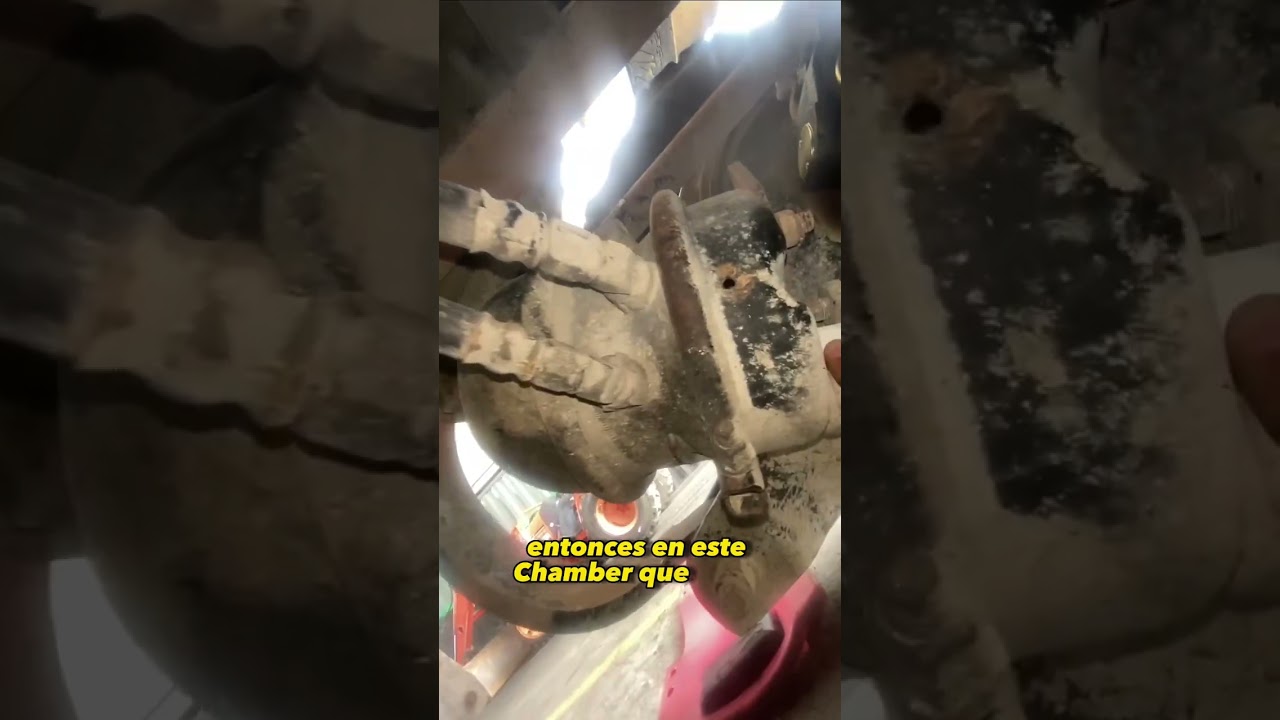
A brake pushrod measurement cannot be interpreted on its own. Before comparing it with a chart, the technician needs to identify the installed chamber and the test conditions. For a driver or fleet owner, the useful question is: which component was measured, and which reference was used to evaluate it? An isolated number does not establish that the system is sound.
Archive image from The Truck Savers™ for topic context. It does not document a diagnosis, a measurement, or a service performed for this article.
Rated stroke, applied stroke and free movement
Rated stroke describes a chamber design characteristic. Applied stroke is travel during a service-brake application under the manufacturer’s specified conditions. Free movement is a different check and does not replace that measurement. MGM Brakes expressly distinguishes the rated stroke marked on the chamber from the adjustment limit: they are different values. Source: https://www.mgmbrakes.com/application/files/7217/6940/4832/Identifying_Long_Stroke_Chambers_FINAL.pdf https://static.nhtsa.gov/odi/tsbs/2024/MC-10249791-0001.pdf
There is no “two inches for every chamber” rule. CVSA explains that limits depend on chamber size and on standard- or long-stroke design. It also warns that everyday brake feel from the cab does not establish how the system will respond in an extreme maneuver. Inspection requires appropriate measurements and maintenance, rather than the driver’s impression alone. Reference: https://cvsa.org/programs/operation-airbrake/air-brake-chamber-pushrod-stroke
Identify the component before selecting the chart
Keep the manufacturer, part number, type or size, and legible stroke markings. For its actuators, MGM Brakes documents tags, port shapes or embossments, and letter codes that identify rated stroke. Interpret these features using the product documentation, rather than deciding by resemblance to another chamber. Manual identification section: https://www.mgmbrakes.com/application/files/3917/6941/1034/EB_24-001_MGM_Brakes_S-Cam_Drum__Disc_Actuator_Service_Manual_rev._02.pdf
If a marking is unreadable or identification is incomplete, record the uncertainty and ask for confirmation through the manufacturer or applicable documentation. Do not fill the gap from memory of another truck. MGM’s identification guide notes, for example, that tag color does not itself identify rated stroke. Reference: https://www.mgmbrakes.com/application/files/7217/6940/4832/Identifying_Long_Stroke_Chambers_FINAL.pdf
Identify the section and brake system being inspected
A combination actuator includes a service section and a parking-spring section. The MGM manual identifies them separately. When evaluating pushrod travel during a service-brake application, the reference must match the component and function actually being checked; describing the complete assembly without that distinction leaves the record incomplete. Source: https://www.mgmbrakes.com/application/files/3917/6941/1034/EB_24-001_MGM_Brakes_S-Cam_Drum__Disc_Actuator_Service_Manual_rev._02.pdf
Do not transfer a drum-brake chart or procedure to every disc brake. Confirm the brake system, actuator and application using their manuals. Equipment identification determines the appropriate check; this guide does not establish chamber interchangeability or authorize choosing a replacement by outside diameter.
A result needs its measurement conditions
An applied-stroke reading requires the preparation and conditions specified for that test. DTNA’s S2 Chassis manual links its drum-brake check to a chart by manufacturer, type and size, under defined application conditions. It is a specific example, rather than a procedure for every truck. Consult the manual that applies to your vehicle. Source: https://www.dtnatechlit.com/portal-public/0000122350-s2-chassis-maintenance-manual/0000122350.xml/%24/0000121149
Ask for a record that distinguishes the reading, its unit, application conditions and the referenced limit. Also ask which manual edition, axle and side were checked. Comparing values without that information can mix different checks. Vehicle preparation and work beneath it require trained personnel using the manufacturer’s safe procedure; roadside do-it-yourself steps are not provided here.
An automatic adjuster does not eliminate inspection
If excessive stroke is found, do not assume turning an adjuster is enough. DTNA warns that manually adjusting an automatic slack adjuster to bring travel within the limit may mask a mechanical problem. Inspection must investigate the system and its components; adjustment is not the same as repair. Source: https://www.dtnatechlit.com/portal-public/0000122350-s2-chassis-maintenance-manual/0000122350.xml/%24/0000121149
An out-of-reference result does not by itself identify the failed part. Ask for the finding, the check performed and the recommended action. MGM Brakes prohibits disassembling the sealed spring section because of its stored energy. This explanation is not a guide to opening chambers, releasing springs or modifying components. Manufacturer safety reference: https://www.mgmbrakes.com/application/files/3917/6941/1034/EB_24-001_MGM_Brakes_S-Cam_Drum__Disc_Actuator_Service_Manual_rev._02.pdf
What to bring and what to request from the shop
A useful record can include: vehicle and configuration; date; axle and side; manufacturer and part number; type and stroke design; legible markings; reading and unit; conditions and procedure used; limit reference; findings; completed work and pending items. It helps a discussion with the technician; it is not an official form or compliance certification.
Hypothetical example, not a customer case: two trucks have similar readings, but their chambers have different identification. Before calling both “good” or “bad,” confirm their references and measurement conditions. Neither a shared reading nor a documented repair alone guarantees passing an inspection; the condition of the complete system still matters.
For truck and trailer brake service in Houston, contact The Truck Savers™. Share your vehicle identification and available records, and confirm the inspection scope before work begins. A documented measurement helps frame specific questions; it does not replace professional diagnosis or certify the complete system.
Need help with your truck?
Our team of experts is ready to help you. Schedule a free "La Bailada™" inspection and discover the real condition of your truck.