
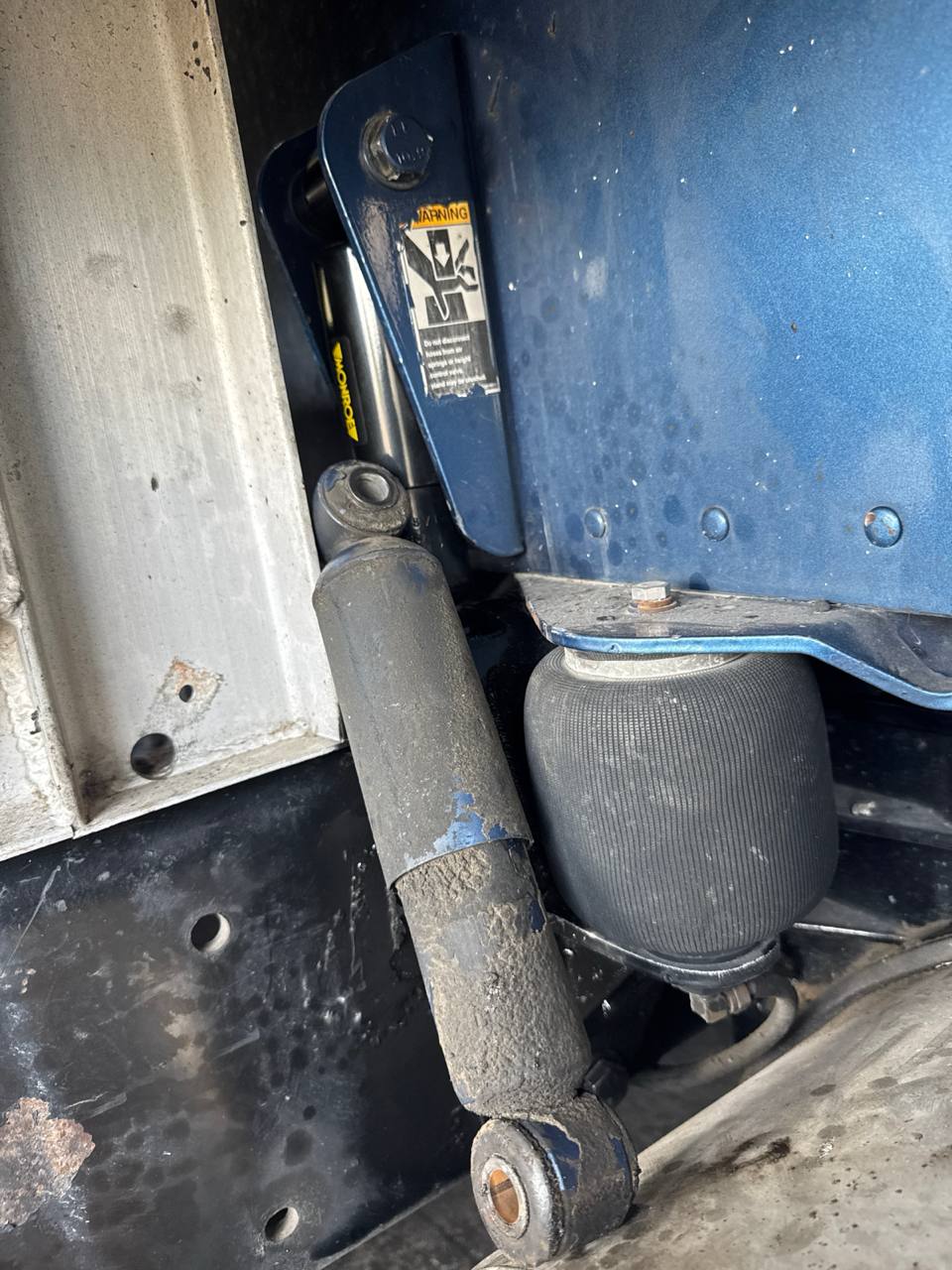
On a truck, most of us pay attention to tires, brakes, suspension, steering, the engine, or the transmission. But there is one part that often gets ignored until it really starts bothering the driver: the cab shocks. Even though they look like small components, their job is very important for the operator and for the safety of the truck.
A cab that keeps bouncing down the road is not just uncomfortable. It can also affect the operator’s health, increase fatigue, cause back, neck, and shoulder pain, and in more serious cases affect driving safety. A driver who is bouncing, taking every road impact, and fighting the cab for hours does not drive the same as an operator who is stable, comfortable, and has proper control of the steering wheel.
What cab shocks do
Cab shocks have one clear function: to control cab movement. When the truck goes over a pothole, uneven pavement, bridge, yard entrance, or rough road, the cab moves. That movement is normal. What is not normal is for the cab to keep bouncing, rocking, or hitting after the impact.
The shock is not there only to make the ride softer. Its job is to control rebound. It helps the cab move up and down in a controlled way, without excessive movement. In simple words: the air bag helps support and cushion; the shock controls the bounce.
What the cab air bag does
The cab air bag is also part of the comfort system, but it does not do exactly the same job as the shock. The air bag helps support the weight of the cab and absorbs part of the vibration. It works with air, pressure, and height so the cab is not sitting rigidly against the chassis.
But the air bag cannot do the whole job by itself. If the air bag is good but the shock is worn out, the cab can still keep bouncing. And if the air bag is damaged, low, dry-rotted, cracked, or leaking, it can also cause hard impacts, uneven height, or excessive movement. That is why the whole system must be inspected: air bag, shock, bushings, mounts, air lines, leveling valve, and hardware.
Why almost nobody pays attention to them
Because they are not always easy to see. They do not get attention like a worn tire, a major oil leak, or noisy brakes. But the operator feels them: in the back, in the neck, in the fatigue, and after long hours behind the wheel.
A cab that bounces every day does not only wear out parts. It also wears out the operator.
A cab with worn-out shocks can make the driver end the day more tired than normal. And when the body receives impact after impact, trip after trip, that adds up. It is not just comfort. It is health.
Comfort is also safety
Sometimes we think comfort is a luxury. But in a truck, comfort is also connected to safety. If the cab is bouncing too much, the operator can lose focus, get tired faster, make more steering corrections, and feel less stability. If the body is bouncing, it can also affect how the driver reacts in an emergency.
The question is simple: if the driver does not have good control of the steering wheel, how safe is that truck really? The cab system helps the operator stay in a more stable position, drive more comfortably, and feel the road more accurately.
How to know if they are damaged
- The cab bounces too much after going over a pothole or uneven surface.
- You hear hard knocks, clunks, or bottoming-out noises in the cab.
- The cab feels loose, unstable, or like it is floating.
- There are visible oil leaks on the shock.
- The bushings are broken, worn, dry, loose, or deformed.
- The mounts, brackets, or hardware are damaged or loose.
- The air bag shows cracks, dry rot, leaks, incorrect height, or wear.
Important: just because a shock does not show a visible leak does not mean it is good. A shock can be worn internally and still show no oil on the outside. That is why you need to combine visual inspection, a road test, and a full system check.
The test very few people do: checking temperature
Besides checking for leaks, bushings, and damaged parts, there is a very useful test after a trip: checking the temperature of the shock. A shock that is working turns movement into heat. That is why, after driving, it should normally have some temperature.
If after a trip one shock is noticeably colder than the other, or it shows no sign of working, that can be a clue that it is not functioning correctly. The best way is to compare them carefully or use an infrared temperature gun. If one side is warm and the other is cold, there may be a difference in how they are working. If both are cold after a route where they should have been working, there may be internal wear.
How often should they be replaced
There is not one single answer for every truck. It depends on the type of unit, operating weight, road conditions, city or highway use, yards, construction work, part quality, previous maintenance, and driving style. But as a practical rule, cab shocks should be inspected during every major preventive maintenance service.
If the truck works in heavy conditions or on rough roads, they should be inspected more often. If they have been on the truck for several years, if the operator notices excessive bouncing, or if the cab air bags were already replaced but the problem continues, it may be time to consider replacing the shocks. Do not wait until they are completely destroyed.
Common mistake: replacing the air bag and forgetting the shock
A very common mistake is thinking every cab problem comes from the air bag. Yes, the air bag can fail. It can leak, dry out, crack, or lose height. But if you only replace the air bag and do not inspect the shock, the problem can continue.
The air bag can lift the cab, but it does not control rebound like the shock does. If one component is new and the other is worn out, the system is incomplete. It is like replacing a tire while leaving the alignment wrong: the new part will not perform the way it should because the root problem is still there.
Conclusion
Cab shocks are not a luxury part. They are part of the system that helps the operator drive more comfortably, more stable, and safer. The air bag helps support and cushion. The shock controls the bounce. The bushings and mounts keep everything firm.
If your cab bounces too much, hits hard, feels loose, or you already replaced the cab air bag and the problem continues, bring your truck to Truck Savers. We inspect the full system to find the real cause before changing parts blindly. The parts never lie. Learn about our shock absorber service at https://thetrucksavers.com/en/houston/shock-absorbers.
Schedule an inspection before paying for a failure
If this topic sounds familiar, don't wait for the truck to hand you the biggest bill. At The Truck Savers we can help you inspect your unit, detect early signals, and make decisions that protect your business.
Learn about our services in Houston, Dallas, and Monterrey, or see how a Go Green APU can help you when the issue is diesel, idle time, and cab comfort.
Need help with your truck?
Our team of experts is ready to help you. Schedule a free "La Bailada™" inspection and discover the real condition of your truck.