A vibration that appears at highway speed can lead to an expensive chain of guesses: balancing again, replacing a tire, checking alignment, and changing parts without first confirming what is actually happening. The problem is that a tire can be balanced by weight and still fail to roll perfectly round.
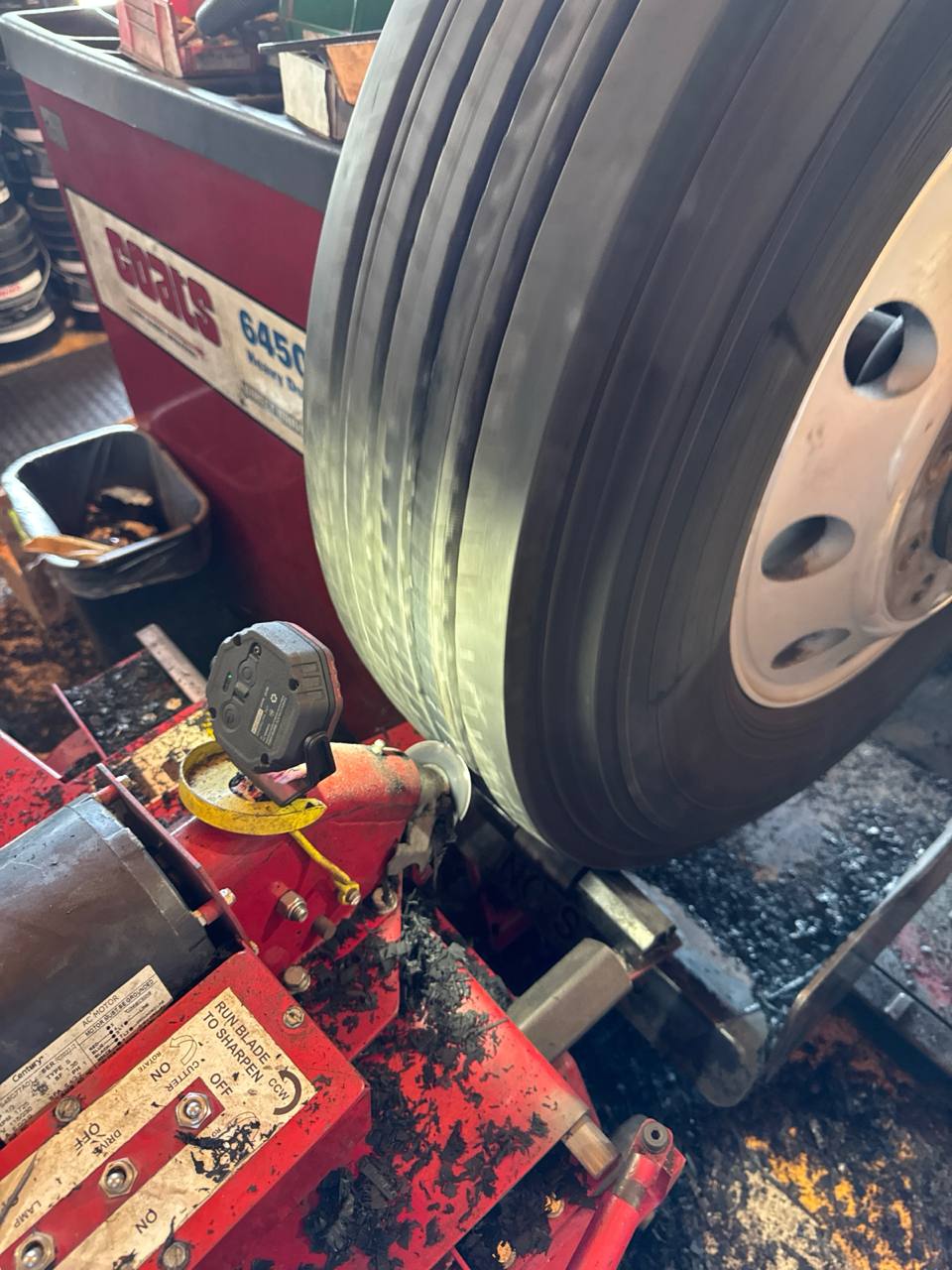
The photograph in this article shows a shop process known as tire shaving. A blade removes rubber in a controlled manner while the tire rotates. At first, it seems contradictory: why remove rubber from a tire we want to protect? The answer begins with understanding the difference between balancing weight and correcting shape.
Balancing and tire shaving do different jobs
Balancing compensates for weight differences in the tire-and-wheel assembly. Tire shaving, when measurements show that it is appropriate, works on high spots in the tread to improve the uniformity of an out-of-round tire. One operation addresses weight distribution; the other addresses the shape the tire presents as it rolls on the road.
A tire can be balanced and still create vibration if it does not roll uniformly.
What does an out-of-round tire mean?
It means that the effective radius is not completely uniform during each revolution. Instead of contacting the road evenly, some points may work harder than others. Depending on the severity and the rest of the system, the driver may feel vibration, hopping, or a condition that is mistaken for a balancing problem alone. Uneven wear may also appear, but the wear pattern by itself does not prove the cause.
That is why a diagnosis should not be based only on a photograph or the statement that the truck “vibrates at a certain speed.” Tire pressure, load, mounting, centering, the wheel, balancing, alignment, suspension, and loose components must be inspected. Then the tire is measured. The evidence determines whether tire shaving makes sense.
How the process should be performed
- Inspect the tread, casing, and complete assembly before removing material.
- Verify tire pressure, mounting, and wheel centering.
- Measure radial variation and locate the high spots.
- Remove only the necessary rubber with proper equipment and trained personnel.
- Measure again and verify the result before returning the unit to the road.
The goal is not to cut the tire by eye. It is to remove material from the high spots in a controlled way while respecting the condition and available tread depth. When the shape is corrected and the underlying cause is also resolved, the tire may begin or continue its service life under more uniform operating conditions.
What tire shaving does not fix
A Tire Shaver does not straighten a damaged wheel, tighten loose components, center a wheel by itself, replace balancing, or correct defective alignment or suspension. If a mechanical cause is behind the vibration or wear, shaving the tire without resolving that cause may temporarily hide the symptom while the problem continues.
- Wear caused by incorrect pressure or uneven load distribution.
- Alignment outside specification.
- Bushings, tie-rod ends, kingpins, or other loose components.
- An off-center wheel, brake drum, or wheel assembly.
- Structural damage, separation, or another unsafe tire condition.
Is removing rubber the same as wasting it?
The better question is not how much rubber we see falling, but how much material the tire could lose unevenly if the high spot continued hitting and scrubbing for thousands of revolutions. A controlled, measured cut is not the same as allowing the road to wear the tread without control. Even so, not every tire is a candidate, and no specific mileage should be promised without knowing the application, load, and full condition of the truck.
Find the cause before buying another tire
If your truck still vibrates after balancing, if a tire shows uneven wear, or if you already replaced parts and the symptom returned, stop diagnosing by committee. At Truck Savers, we inspect the complete system to find the real cause and determine whether the solution involves pressure, centering, balancing, alignment, suspension, or correcting an out-of-round tire.
Bring your truck to Truck Savers for a La Bailada inspection before buying another tire or replacing more parts. The tire shows the symptom; we look for the cause. The iron never lies. Learn about tire shaving in Monterrey at https://thetrucksavers.com/en/monterrey/tire-repair, our tire balancing at https://thetrucksavers.com/en/houston/tire-balancing, and the anti-vibration solutions at https://vibrasavers.com.
Schedule an inspection before paying for a failure
If this topic sounds familiar, don't wait for the truck to hand you the biggest bill. At The Truck Savers we can help you inspect your unit, detect early signals, and make decisions that protect your business.
Learn about our services in Houston, Dallas, and Monterrey, or see how a Go Green APU can help you when the issue is diesel, idle time, and cab comfort.
Need help with your truck?
Our team of experts is ready to help you. Schedule a free "La Bailada™" inspection and discover the real condition of your truck.